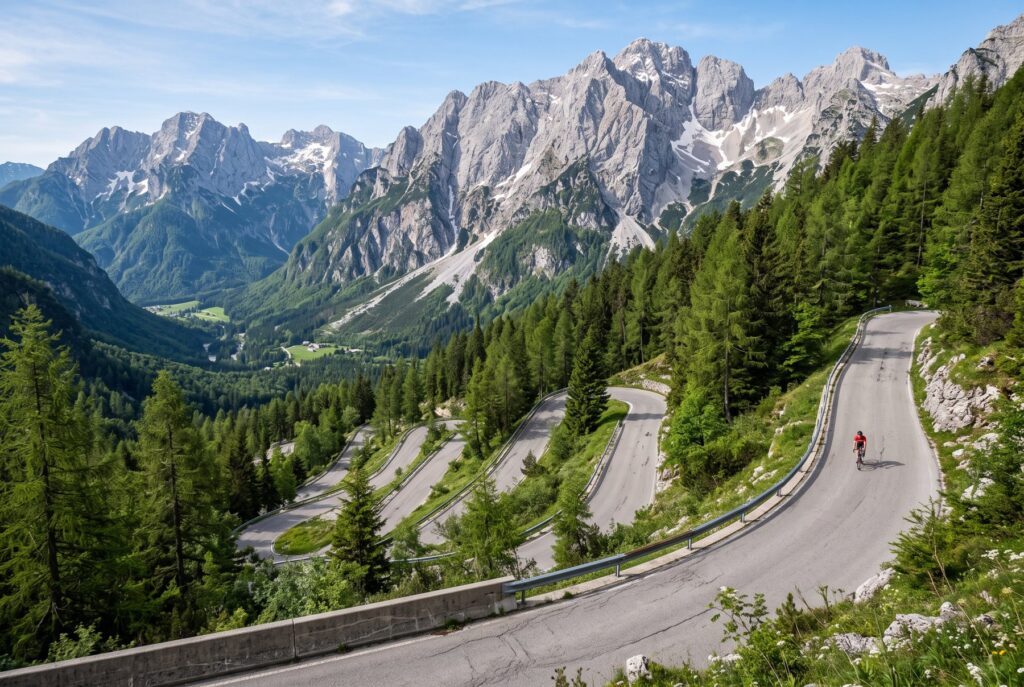
Short answer: Vršič Pass is the highest road pass in Slovenia at about 1,611 m (5,285 ft), linking Kranjska Gora in the Upper Sava Valley with the Trenta and Soča valleys. From the Kranjska Gora side it is roughly 11 to 12 km with around 800 m of climbing at an average of about 7%, over a road famous for its numbered hairpins and cobbled bends. It is a climb most fit gravel riders can enjoy at their own pace, and one of the most beautiful in the Alps.
The climb from Kranjska Gora
This is the classic direction and the one we ride. The road leaves Kranjska Gora at around 810 m and climbs steadily through larch and spruce forest. The hairpins are numbered on signs, so you always know where you are, and several on this side are surfaced with cobbles. They are rideable, but they are slow and rough, so stay seated, keep your weight even and pick a smooth line on the inside of the turn only if traffic allows.
About halfway up you pass the Russian Chapel, a small wooden chapel built by Russian prisoners of war. They were forced to build the road during the First World War, and many were killed in an avalanche in 1916. It is worth a stop.
Near the top the forest opens up and the limestone walls of the Julian Alps close in on both sides. The summit has mountain huts serving food and drinks in season, and plenty of space to pull on a jacket before the descent.
The south side, from Bovec and Trenta
Climbing from the Soča side is a much longer effort: roughly 30 km from Bovec with more than 1,200 m of climbing. The early kilometers along the Soča are gentle, but the final stretch is steep, averaging close to 10% for several kilometers. Most riders, including our groups, climb from the north and descend this way, which turns the south side into a long, spectacular run down to the river.
Descending into the Soča Valley
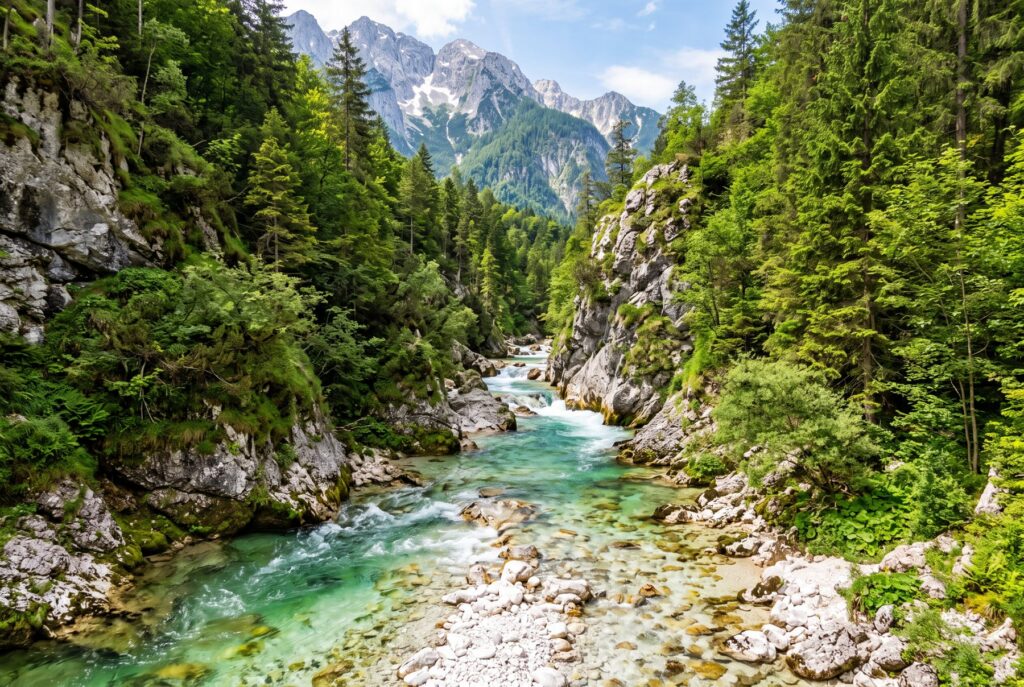
The descent drops through the Trenta Valley alongside the infant Soča, one of the most strikingly colored rivers in Europe. It is cold at speed even in summer, so bring a windproof layer and full-finger gloves. Brake before the hairpins, not in them, and expect cars and motorcycles on summer weekends.
Tips for riding Vršič on a gravel bike
- Gearing: a low gear around 1:1 or easier makes the climb far more enjoyable.
- Tires: your normal gravel tires are fine; drop the pressure slightly for the cobbles.
- Timing: start early. Traffic builds through the day and afternoon storms are common in summer.
- Layers: the summit can be 10°C (18°F) colder than the valley.
- Water: fill up in Kranjska Gora; there is food at the top in season.
When can you ride it?
Vršič is typically closed or unreliable in winter and can hold snow well into spring. June to September is the dependable window, which is why our Julian Alps & Soča Valley trip runs June 9 to 17, 2027. Day 7 rides Kranjska Gora to Vršič Pass, down through Trenta and on to Bovec: about 50 km with 1,100 m of climbing, with the support van close behind if you want a lift at any point. For more on seasons, see our guide to the best time to ride in Slovenia.
Frequently asked questions
How hard is the Vršič Pass climb by bike?
From Kranjska Gora it is about 11 to 12 km with around 800 m of climbing, averaging roughly 7%, with cobbled hairpins near the bottom. It is a solid climb but very manageable on a gravel bike with low gearing and a steady pace.
How high is Vršič Pass?
The summit is about 1,611 m (5,285 ft) above sea level, making it the highest road pass in Slovenia.
Is Vršič Pass paved?
Yes. The pass road itself is tarmac, with cobbled sections on the hairpins on the Kranjska Gora side. Gravel riding in the area is on forest roads in the surrounding valleys.
When is Vršič Pass open for cycling?
The road is normally closed or unreliable in winter and can hold snow into spring. From June to early autumn it is usually open. Check conditions before you go.